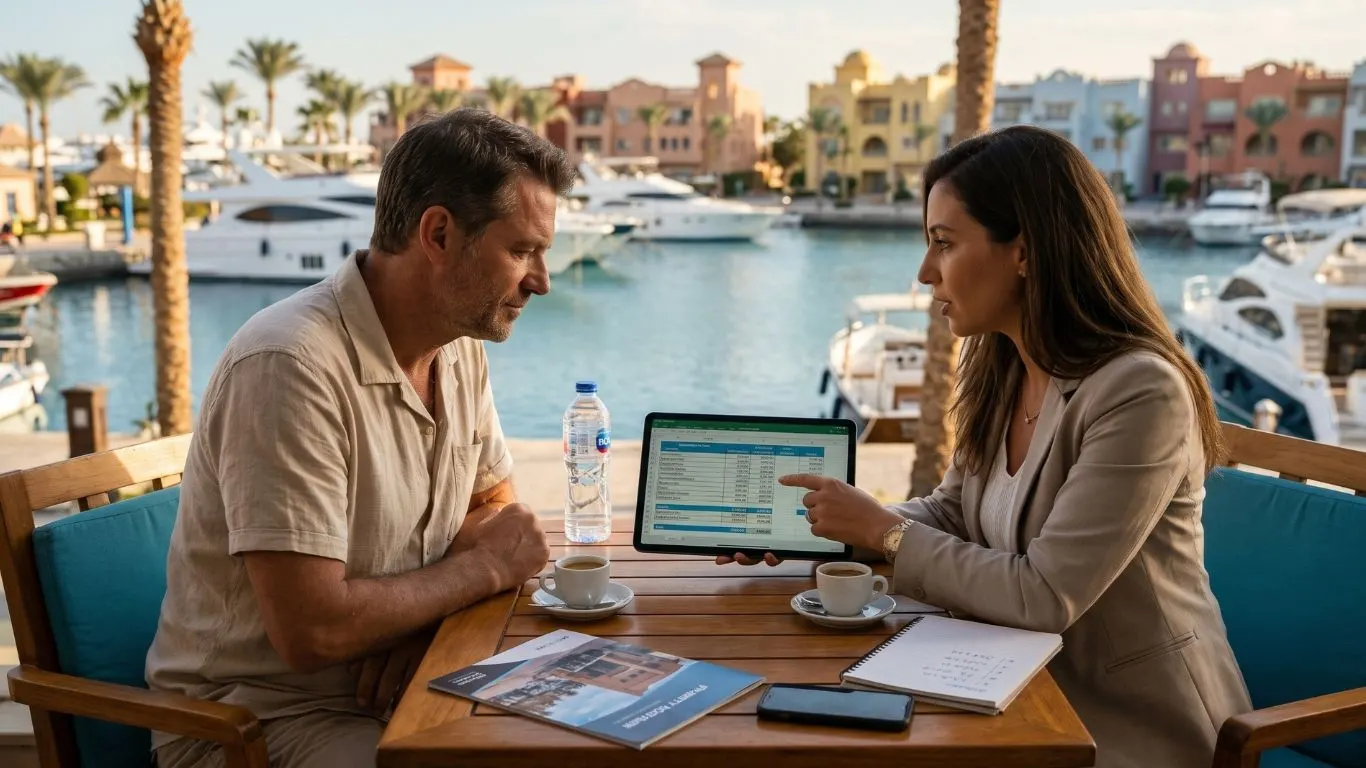
Every buyer I have ever sat down with at Hurghada Marina asks the same first question: “What does it cost?” And every buyer I have ever sat down with asks the second question about three espressos later, usually with a slightly lowered voice: “And what does it cost after that?”
That second question is the one this article answers. The purchase price is a single, satisfying number on a contract. Running costs are a dozen smaller numbers that arrive by post, by email and, in my experience, always on the one week you are trying to enjoy a holiday. Egypt is not unusual in this, but the line items are different from what a buyer in Manchester or Munich is used to, and nobody tells you which ones matter until the first invoice lands.
So let’s go through them properly. This is a guide to the true annual cost of owning an apartment or villa on the Red Sea: service charges, property tax, insurance, electricity, and the tax on rental income if you decide to let the place out. I have used published sources and quoted them in the text, and where the sources disagree I say so rather than pick the number I like best.
The Short Version Before the Long Version
If you only read one paragraph, make it this one. For a typical managed apartment in a Red Sea resort, the recurring bills fall into four buckets: a service charge to the compound or developer, an annual real estate tax, insurance, and your own utilities. The first of those is almost always the big one, and it varies enormously between a basic managed development and a premium resort with golf, marinas and a lifeguard on every beach. The second is, pleasantly, small. Everything else depends on how you use the property and whether you rent it out.
Service Charges: The Line Item That Decides Everything
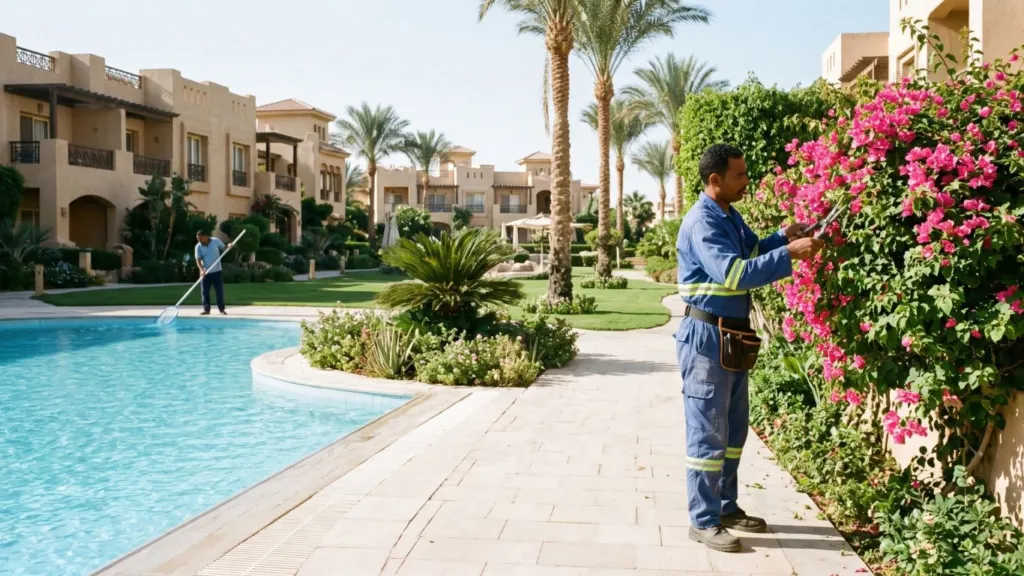
Service charges, sometimes called maintenance fees, pay for what makes a compound feel like a compound: security at the gate, landscaping, pool care, lifts, common-area electricity and general upkeep. Think of it as the Egyptian cousin of a UK leasehold service charge, with better weather and, if we are being honest, a more cheerful gardener.
The published numbers vary a lot, which is itself useful information. The international property agency Global Investments, in its buying-costs guide for Egypt (updated June 2026), puts service charges and maintenance at roughly US$1,000 to US$2,500 a year for basic managed developments, US$2,500 to US$5,000 for mid-tier resorts and compounds, and US$5,000 to US$15,000 or more for premium resorts. Its summary table gives a narrower band of US$1,000 to US$4,000. The guide’s own advice is blunt and correct: always confirm what is included.
Then there is the Egyptian marketplace Nawy, which in a guide to compound maintenance fees (last updated 15 October 2026) says the annual recurring charge is about 2% to 5% of the unit’s price. Nawy is a property marketplace and therefore an interested party, so treat the figure with the same caution you would apply to any estate agent’s brochure. But it is worth noticing the gap. On a US$150,000 apartment, 2% to 5% is US$3,000 to US$7,500 a year, which sits well above the lower tiers in the Global Investments guide. I would read that as a sign that the percentage rule of thumb is, at best, a description of the pricier end of the market and not a safe average.
My practical advice, and the one thing I would tattoo on every buyer if the law allowed it: ask the developer or management company for the current service charge per square metre, in writing, together with the last three years of increases. Multiply it by your unit’s built area. That is your number. Not a guide’s number, not mine.
The Deposit Nobody Mentions Until Signing
Many compounds also levy a one-off maintenance deposit, often called a “wadiaa” or sinking fund. According to the same Nawy guide, it is typically around 8% to 10% of the purchase price, paid once to the developer and meant to fund major structural repairs and long-term facility renewals. The guide is slightly inconsistent about timing, with one section saying it can be paid in instalments until delivery and another saying it is due when the contract is signed, which is exactly why you want it in your payment schedule in black and white.
This is not a running cost, strictly speaking, but it is the number most likely to turn a comfortable budget into an awkward one. If you are comparing a new project with a finished one, the deposit is a major reason the two are not like for like. Our comparison of off-plan versus resale on the Red Sea walks through how it fits into the wider payment plan.
Annual Property Tax: Smaller Than You Fear
Egypt levies an annual real estate tax under Law 196 of 2008. The part that surprises British buyers is how it is calculated. It is not a percentage of what you paid. According to Global Property Guide‘s overview of taxes and costs in Egypt, the rate is 10% of the net assessed annual rental value, after a statutory deduction of 30% for residential property, and the value is set by the Real Estate Tax Authority rather than being tied directly to your purchase price or the current market value. Reassessment generally happens about every five years.
The same guide notes that a residential unit used as an owner’s principal family residence is exempt where its net assessed annual rental value does not exceed EGP 24,000, but it stresses this applies to one principal residence per family and should not be treated as a general exemption for investment or rental properties. A holiday apartment in Hurghada that you let for a few weeks a year is, I would say, unlikely to qualify, so budget for the tax and be pleasantly surprised if you are told otherwise.
How much will it actually be? Global Investments estimates US$100 to US$800 a year in its text and US$100 to US$500 in its summary table, noting that the assessed rental value is usually well below true market rent. Even at the top of that range, the property tax on a Red Sea apartment is a rounding error compared with the council tax bill you may be happily leaving behind in Leeds.
Insurance: The Boring Line That Saves the Year
Global Investments suggests US$300 to US$800 a year for a standard unit in a managed development, and uses about US$500 in its worked example. Do you have to insure? Not necessarily by law, but a holiday home that sits empty for half the year, with a pool nearby and a summer sun doing its best impression of a hairdryer, is exactly the kind of property you want covered. Ask the compound what the building policy already includes, so you do not pay twice for the same roof.
Electricity: Cheap Until It Isn’t
Here the news is good, with a caveat. Egyptian household electricity is priced in consumption tiers. Egypt Independent, reporting in July 2026, listed the household tariff as 68 piasters per kWh for the first 50 kWh, 78 piasters for 51 to 100, 95 piasters for 101 to 200, EGP 1.55 for 201 to 350, EGP 1.95 for 351 to 650, EGP 2.10 for 651 to 1,000 and EGP 2.58 above 1,000 kWh. The same report said the top tier rose from EGP 2.23 to EGP 2.58, a 16% increase, while the other residential tiers were left unchanged.
Compared with a UK bill, these are modest numbers. The caveat is the air conditioning. A Red Sea apartment in August is not a place where you economise on cooling, and a few weeks of heavy use can push consumption into the higher tiers. Two practical points follow. First, ask whether your compound bills electricity directly to owners or passes it through the developer, because the rate you pay may not be the household tariff above. Second, if you are buying a second home that stays empty, ask how the meter is handled when you are away. Nobody wants an invoice for a fridge that was only ever visiting.
For new-city properties there can also be a one-off connection and metering charge. Global Investments quotes EGP 10,000 to EGP 30,000 for properties in NUCA new cities, which is worth confirming with the developer if you are buying somewhere recently built.
A Worked Year: What an Apartment Might Really Cost
Let’s put the sourced ranges together. The table below uses the lower and upper bands from the Global Investments summary figures for a managed Red Sea apartment that you keep for your own use. It is an illustration, not a quote, and your own unit will land somewhere in or beyond the range depending on the compound.
| Annual item | Low (US$) | High (US$) |
|---|---|---|
| Service charge and maintenance | 1,000 | 4,000 |
| Annual real estate tax | 100 | 500 |
| Insurance | 300 | 800 |
| Subtotal before utilities | 1,400 | 5,300 |
Add your own electricity, water, internet and any cleaning or key-holding service, which depend on how often you visit. For reference, Global Investments’ own example for a US$300,000 purchase totals roughly US$3,300 in year one, made up of about US$300 in property tax, about US$2,500 in maintenance and about US$500 in insurance. That is a comfortably modest figure, but it is a mid-range example and not a promise for a beachfront villa with its own pool.
Whatever the number, the useful habit is to ask for it before you reserve, not after you collect the keys. A good developer or agent will hand it over without blinking. A less good one will explain that “it depends.” It does depend. That is why you ask.
If You Rent It Out: The Tax and the Maths
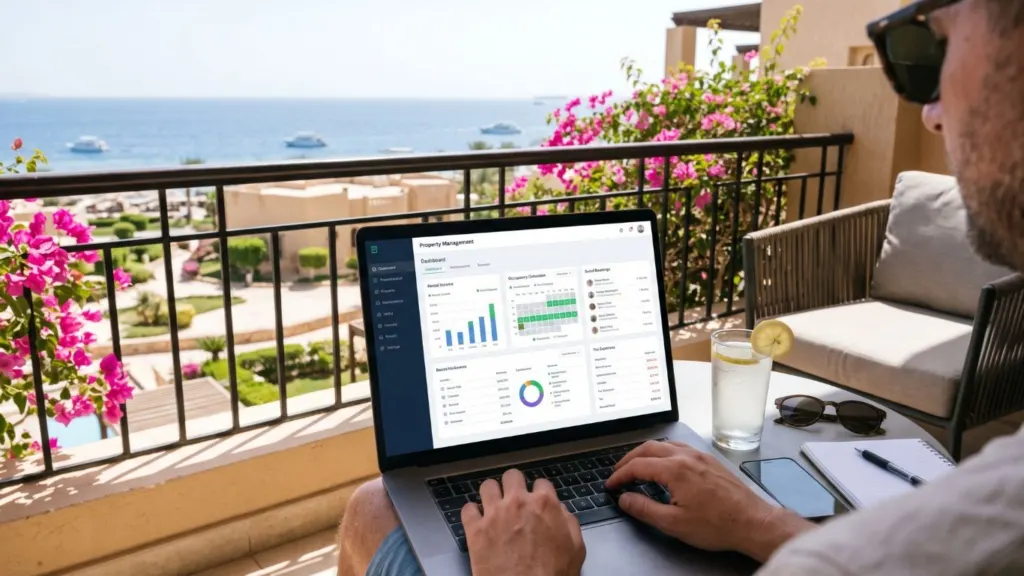
This is the section investors skip straight to, so let’s do it carefully. According to Global Property Guide, rental income from Egyptian real estate is generally taxed at progressive personal income tax rates running from 0% on income up to EGP 40,000 to 27.5% on income above EGP 1,200,000, with a deemed allowance of 50% of gross rental revenue for costs, so only half of your rent enters the taxable base. Non-residents are generally taxed on Egyptian-source income, which includes rent from a property in Hurghada. If you live in the UK or in a DACH country, you should also check how your home country treats that income and whether a double taxation treaty gives you credit for tax paid in Egypt.
If you are weighing up the income side, our deeper look at rental yields in Hurghada and Sahl Hasheesh after costs shows how the same service charges and management fees eat into a headline yield. The honest summary is that costs matter more than most glossy brochures admit, and the numbers above are the reason.
Selling Later: The Tax That Waits for You
Running costs are only half of the ownership picture. Global Property Guide notes that an individual selling built property is generally subject to a 2.5% real estate disposal tax on the gross disposal value, not on the gain, and that acquisition and improvement costs generally do not reduce that base. It is not a cost you pay each year, but it belongs in the same spreadsheet, because it affects what a resale actually returns. If you have not yet mapped out how the money moves in and out of the country, start with our guide to moving money to Egypt for a property purchase.
How to Compare Two Properties Fairly
Here is the little checklist I give buyers who are choosing between two developments. It is short, and it will save you from the most common mistake, which is comparing price tags without comparing what you pay to keep the lights on.
- Ask each compound for the current service charge per square metre and the percentage increase over the last three years.
- Ask what the charge includes: pool, beach access, gym, shuttle, security, cleaning of common areas, and whether utilities are billed separately.
- Ask whether a maintenance deposit applies, how much it is, and when it falls due in the payment plan.
- Ask how the property is assessed for real estate tax and when it was last assessed.
- Ask who handles electricity and water billing, and at what tariff.
- Ask for the property management fee in writing if you plan to let it, and whether it is deducted before or after platform commission.
Put the answers side by side and the cheaper-looking property sometimes turns out to be the pricier one over ten years. Equally, the apartment with the high service charge can be the better buy if that charge includes a beach club that you would otherwise pay for separately.
Where the Costs Differ on the Coast
The Red Sea Riviera is not one market. A managed apartment in a large, established resort at Sahl Hasheesh will carry different service charges from a smaller block in the middle of Hurghada, and both will differ from a golf-led development at Soma Bay or a lagoon-side home in El Gouna. That is why a blanket “percentage of price” rule is risky, and why the better question is always “what do the amenities cost per square metre here?”
If you are still shortlisting, browse the current properties for sale and the development projects we work with, and ask us for the service-charge sheet for any that catch your eye. We would rather you saw the full cost of ownership today than found it out in the second year.
And if you are doing your sums on a grey afternoon in November, with a cold cup of tea and a heating bill that looks like a phone number, you may find that a Red Sea terrace in December is cheaper to run than the British winter you have been paying for all along. I would not stake my reputation on it, but I would at least run the numbers.