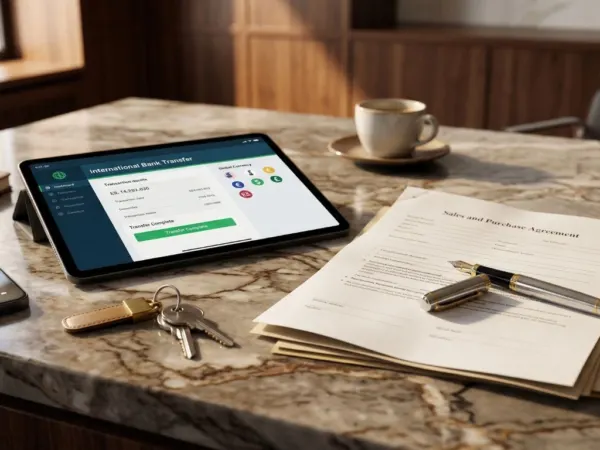
There is a moment in almost every Egyptian property purchase when somebody leans across a desk, smiles warmly and says, “Don’t worry, you will get the green contract.” It is said with the confidence of a man promising that the tea is on its way. And, as with the tea, the sensible response is to ask when, in what form, and who is paying for it.
The confusion is understandable. Terms like “green contract”, “Sahha wa Nafaz” and “signature validation” get tossed about as if they were interchangeable, when they describe quite different things: one is a finished title, one is a court route to get you there, and one is a stepping stone that looks more impressive than it is. If you are buying on the Red Sea, whether in Hurghada or Sahl Hasheesh, knowing which is which is probably the single most useful piece of homework you can do before handing over a deposit.
This guide is the plain-English version, with the sources named so you can check our working. It is an explainer, not a substitute for an independent Egyptian lawyer, and we will say where that lawyer earns their fee.
The short version, for people who like their answers before their espresso
Ownership in Egypt is only properly complete once it is registered. Everything else is a rung on the ladder. A “green contract” is the everyday name for the end of that ladder: the final registered deed. “Sahha wa Nafaz” (you will also see Sihha wa Nafaz or Sahat wa Nafath) is a lawsuit you bring when the other side will not complete the paperwork, and a final judgment can stand in for the seller’s signature at the registry. Signature validation is a far humbler court step that confirms who signed, and nothing more.
What people mean by a “green contract”
In casual conversation across the Red Sea, the green contract is shorthand for proof that you genuinely own the unit. AlZayat Law Firm, in its guide to property ownership registration in Egypt, describes true ownership as coming only from official registration, which produces a final registered deed, “often referred to as a ‘Green Contract'”, and states that any other document is not proof of ownership. That is a refreshingly blunt line, and it is the one to keep in your head.
A word of honest caution: the phrase is used loosely. Some sales teams use “green contract” to describe the developer’s own contract, simply because it is a handsome document with a stamp on it. The test is not the colour of the paper. The test is whether the document has been registered in your name through the real estate registry (the Shahr Aqari, in local parlance). If you cannot answer that question with a document number and a registry office, you do not yet hold the thing people are describing.
How a document reaches that final stage
According to Youssry Saleh & Partners, in a Mondaq briefing on property registration in Egypt from November 2023, the governing framework is the Civil Code (Law No. 131 of 1948), the Real Estate Registration Law (No. 114 of 1946) and the amending law of 2022 (No. 9 of 2022). Their summary of the process runs roughly as follows. An application is filed with the competent registry, in person or online, signed by both parties. Fees are paid, and the application receives a number and a timestamp. The applicant receives a text message within 24 hours confirming acceptance or rejection. If documents are missing, processing is suspended and you have 15 days to fix the gap. Officials then review the file, the registry records the document, and a second text confirms registration. The firm puts the maximum timeline at 37 days, 30 for registration and 7 for complaints, which it contrasts with up to two years under the old regime.
Notice the phrase “if documents are missing”. Most delays we hear about from buyers are not mysterious; they are a missing seller’s title deed, a power of attorney that does not say what it needs to say, or a developer that has not yet completed its own registration of the land. Which brings us neatly to the awkward cousin.
What Sahha wa Nafaz actually is
Sahha wa Nafaz translates, roughly, as “validity and enforceability”. It is a lawsuit, not a document you buy. AlZayat Law Firm explains that where a seller refuses to complete registration, a lawyer files this specific type of case, and a final judgment replaces the seller’s signature at the Shahr Aqari, allowing registration to be completed through the court.
In other words, it is a rescue route. If your seller has vanished to a different continent, changed their mind after the market moved, or has simply gone silent in that very particular way that only people with your money can manage, the court can compel what the seller will not do voluntarily. The judgment is not the finish line, though. You still have to register it. The ladder is the same; you have just borrowed a longer rung to reach it.
This is useful to understand as a buyer for two reasons. First, if a salesperson describes a Sahha wa Nafaz judgment as “the same as” a registered title, politely ask to see the registration. Second, if you are buying a resale unit, check whether a previous owner’s purchase was ever registered at all, because a gap in the chain is exactly where these lawsuits tend to come from. Our resale listings are one place we are particularly careful about that chain.
Signature validation: the poor cousin
There is a third document that gets mentioned in the same breath, which is a court ruling validating the signature on the sale contract. AlZayat Law Firm is quite clear on its limits: a validity-of-signature verdict only confirms the seller’s signature. It does not transfer ownership, and it does not protect you from a third party who successfully registers the property first. They call it a preliminary step rather than the final protection that registration provides.
The Marsad Omran development brief on the 2020 registration amendments makes a similar point from a different angle. Under the Civil Code, it says, ownership transfers only through registered contracts, yet many buyers rely on customary contracts, signature validation rulings, contract validation rulings or powers of attorney. In a dispute, it explains, courts treat these as semi-formal proof, with registration at the top of the hierarchy. It adds that signature validation confirms only the seller’s identity, not the terms of the contract, and that powers of attorney do not transfer ownership.
If that sounds like an argument for registering early, it is. Imagine that an owner sells the same flat twice. It is a rare story, but a real one, and the same brief mentions an Alexandria case in which 177 units were sold to 350 buyers. The buyer who registers first is not necessarily the one who paid first, and “I had a very nice stamp” is not a legal defence.
The four rungs side by side
| Document | What it is | What it proves | What it does not do |
|---|---|---|---|
| Preliminary or customary contract | The signed agreement and deposit between you and the seller or developer | That you and the seller agreed terms | Transfer ownership or protect you against a rival buyer |
| Signature validation ruling | A court step confirming the seller’s signature | Who signed | Transfer ownership or fix the contract’s terms |
| Sahha wa Nafaz judgment | A lawsuit that can replace a refusing seller’s signature at the registry | That the court enforced the sale | Replace registration; the judgment still has to be registered |
| Registered deed (the “green contract”) | The final contract recorded at the real estate registry | That the property is registered in your name | Nothing: this is the goal |
Why this is not a problem you can postpone
Registration has also been getting harder to avoid. According to the Marsad Omran brief, the 2020 amendment (Law 186 of 2020) aimed to pull a very large stock of unregistered homes into the system, including by stopping utility companies from putting services into new owners’ names without proof of registration. The same brief records that implementation was deferred in March 2021 under Law 5 of 2021. Whatever the current state of enforcement when you read this, the direction of travel is plain: the registry is becoming the centre of the system, not a footnote to it.
The UK government’s own guidance for people buying in Egypt, published on GOV.UK, points the same way. It says a property must be registered in line with Egyptian regulations once the contract is signed, and warns that many older buildings are not registered, so buyers should confirm the status. It also advises appointing a lawyer who is experienced in examining property documents and fully independent of anyone else in the transaction, and cautions that the sales contract is not legally binding unless it is bilingual. (Read the full guidance on the GOV.UK page for buying property in Egypt.)
That last point about independence is worth underlining. A lawyer recommended by the person selling you the flat is a little like asking the goalkeeper to referee the penalty shootout. They may be perfectly honest, but you will sleep better with someone who works only for you.
A decision checklist you can actually use
Before you pay anything beyond a modest reservation, work through these questions in order. The cost of asking is a slightly awkward conversation. The cost of not asking is a rather longer one, in an Egyptian court, in Arabic.
- What is the seller’s own title? Ask for the original title deed or, for a new development, proof of how the developer holds the land. If the seller cannot show how they became the owner, stop there.
- Is the property already registered, or will it be? For a resale, ask for the registry details. For an off-plan unit, ask the developer in writing when registration of individual units is expected and who bears the fees.
- Which document will you receive at each payment stage? Match the instalment schedule to documents, so that money and paper move together.
- Is the contract bilingual? GOV.UK advises that a contract is not legally binding unless it is, so insist on it.
- Does any power of attorney expressly authorise sale? The Egyptian Real Estate Platform blog notes that powers of attorney used in transfers must be notarised and must expressly authorise buying or selling real estate.
- Who pays the transfer tax and registration fees? The same platform states that the property transfer tax is typically 2.5% of the declared value and is paid by the seller, with stamp duties, registration fees and brokerage in addition. Have your lawyer confirm the current position for your specific unit.
- Is every payment going through a bank? GOV.UK advises paying through banks rather than in cash, and for off-plan purchases, paying in instalments tied to completion stages.
What this means on the ground in Hurghada and Sahl Hasheesh
In practice, the risk profile depends on what you are buying. A brand-new unit in a large, established development usually comes with a developer that has a procedure for handing over documents, and your job is to understand the sequence and hold them to it. A resale is a different animal: you are inheriting someone else’s paperwork, and every link in the chain matters. That is not a reason to avoid resales, which often represent the best value on the coast. It is a reason to buy them with a lawyer holding the file.
When you browse our current properties for sale or the wider list of developments on the Red Sea, treat the paperwork as part of the price. A unit that is five per cent cheaper because its documents are a mess is not five per cent cheaper once you have paid for the clean-up, and nobody ever stood on a terrace in December saying, “What I love most about this view is the litigation.”
If you want the broader sequence from reservation to handover, our guide to buying property in Hurghada as a UK citizen walks through it step by step, and this article is best read as the detailed footnote to the part about title.
The question to carry with you
If you remember only one thing, make it this: do not ask whether you will get a green contract. Ask which document you will hold on the day you pay, which document you will hold on the day you get the keys, and which one will be registered in your name, with a registry reference you can look up. A good seller answers those without flinching. A seller who changes the subject to the view has, in a way, already answered.