There is a particular kind of silence that falls over a dinner table when someone says, “Yes, but how do I actually get the money there?” Everyone has a view. Someone’s brother-in-law did it through a broker. Someone else read a forum thread from 2019. Nobody has the paperwork to hand. If you are planning to buy a flat or villa on the Red Sea, this is the question that quietly decides whether your purchase is calm or a slow-burning headache, and it deserves better than dinner-table folklore.
So let us do it properly, the way you might over an espresso at Hurghada Marina: what the sources say, what they do not say, and what a sensible British buyer does in the weeks before the first payment leaves their account.
The one rule behind every other rule: keep a paper trail
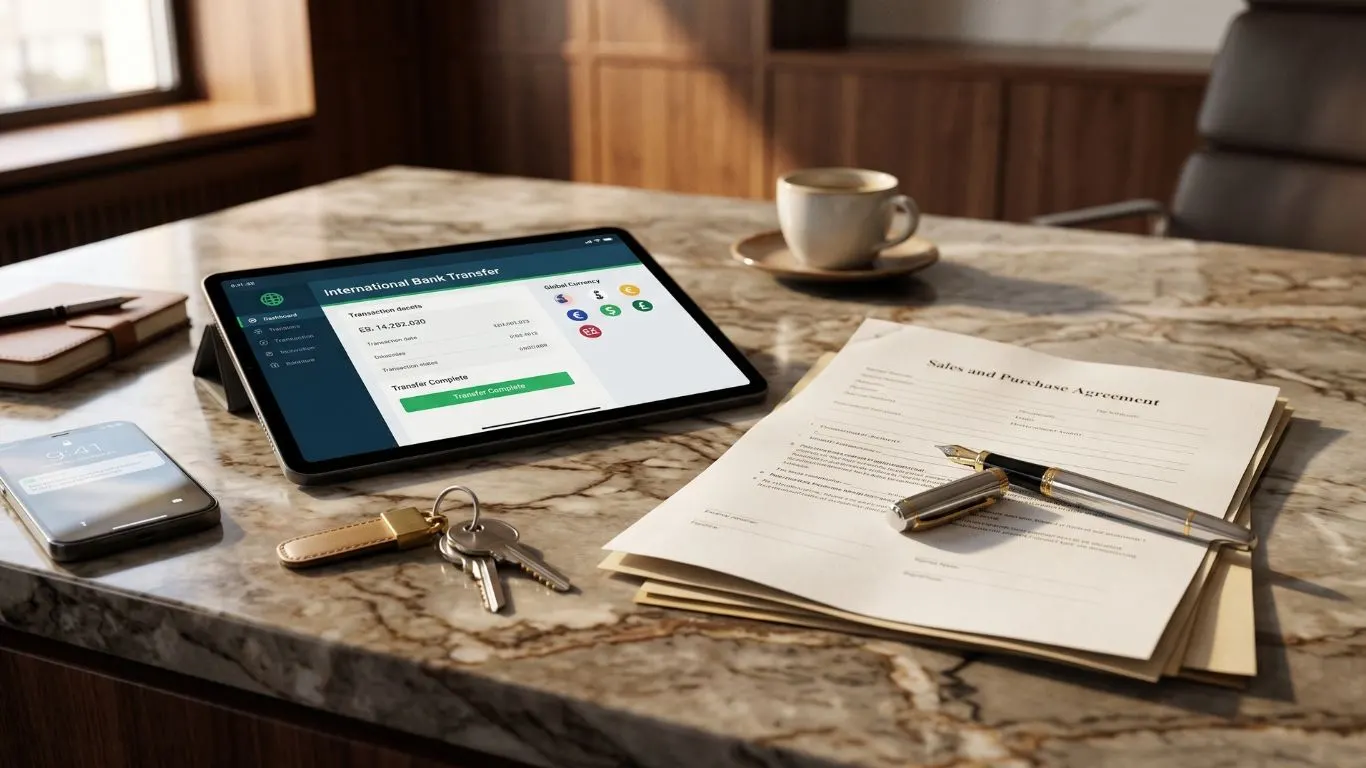
If you take only one thing from this article, take this. According to the Official Egyptian Real Estate Platform’s guide for foreign buyers, published on 15 September 2025, foreigners may bring money into Egypt, but “currency must be exchanged through official channels”, and buyers should keep receipts and documentation of every exchange and bank transfer for legal and tax purposes. The same guide advises insisting on bank transfers and receipts, and being wary of cash-only offers or informal arrangements.
That is not bureaucratic fussiness. It is the foundation of everything that comes later, including your ability to take money back out of the country if you ever sell. Global Investments, in its buying-costs guide updated in June 2026, makes the same point bluntly: keep all records of inward remittances, because that evidence is critical for future repatriation, and on resale a foreign owner is generally expected to show that the original purchase funds arrived through official banking channels.
Think of it as the Egyptian version of keeping your boarding pass until after the holiday. Slightly tedious, wildly useful if something goes wrong.
Foreign currency in: what has actually been required
Here is where the rules have moved in recent years, and where forum posts age badly. Business Today Egypt reported on 6 July 2023 that the Egyptian Cabinet had issued a decree easing restrictions on foreign ownership, removing the old cap of two residential properties per person, while requiring that these transactions be conducted in foreign currency, with the full value of the units paid into a state-owned bank. The stated aim was to bolster foreign currency reserves and attract investment.
Two practical lessons follow. First, “pay in foreign currency” does not mean you must turn up with a suitcase of dollars; it means your funds should arrive as a proper inward transfer, in a currency such as US dollars, pounds or euros, through the banking system. Second, requirements like this can be adjusted by decree, so the version you read in someone’s blog post may not be the version your developer’s finance team is working to this month. Ask them to confirm, in writing, which currency and which account they will accept for your particular unit.
Global Investments adds a useful wrinkle for the resort belt: many developer-priced properties on the Red Sea are quoted in US dollars, and foreign buyers should confirm whether a developer accepts foreign currency or requires Egyptian pounds. If the contract is in dollars, you will be thinking about GBP to USD, or EUR to USD, rather than a direct trip into the Egyptian pound. If it is in pounds, you are taking on exchange-rate exposure whether you like it or not.
Sterling, euros, dollars: where the money actually leaks
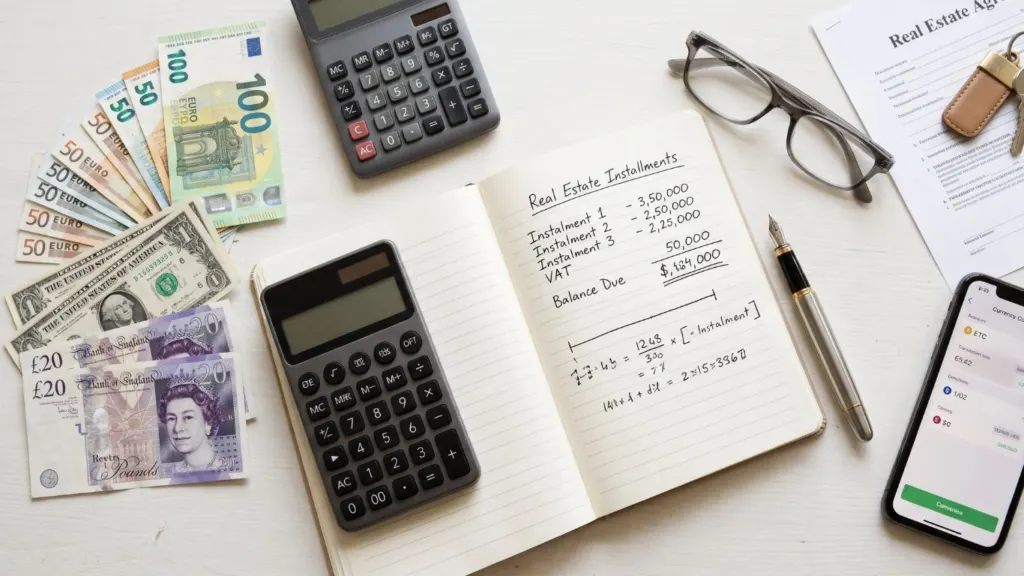
Most buyers fret about the Egyptian exchange rate and then lose a larger sum without noticing, in the spread their own high-street bank takes on the way out. Global Investments puts the conversion cost on a foreign purchase at roughly 0.5% to 2.5% of the transferred sum. On a US$300,000 purchase, that is about US$1,500 at the cheap end and US$7,500 at the expensive end. The same guide’s example suggests that moving from a 2.5% bank rate to a 0.5% specialist-broker rate on US$300,000 saves around US$6,000, and its worked cost table assumes a 0.8% spread on a sterling transfer, or about US$2,400.
Those are indicative figures from a single guide, not a quote, and your own result will depend on provider, amount and day. But the order of magnitude matters. The difference between a lazy transfer and a considered one can cover the legal fees and then some. A few habits that tend to help:
- Compare at least three quotes on the same day, for the same amount, and compare the final amount received rather than the headline rate. Fees hide in the gap.
- Ask whether the receiving account can be in dollars. Global Investments notes that sending USD through an international FX broker to an Egyptian dollar account can avoid the spread charged by a home-country bank.
- Split large payments by milestone, not by whim. If your payment plan has instalments, you do not need to convert everything on day one, though you also should not pretend you can predict the currency.
- Tell your UK bank in advance. A five-figure transfer to a country your bank rarely sees can trigger a call, a hold, or a gentle interrogation about why you are sending it. Better that it happens on your schedule than the developer’s deadline.
Why your bank will ask where the money came from
Every reputable bank, in Britain, Germany or Egypt, will want to know the source of a large transfer. It is not personal. The Egyptian platform’s guide says repatriation of funds such as sale profits is generally allowed, subject to Central Bank of Egypt regulations, and that you must provide evidence of the source of funds. It does not spell out the documents, so the safest approach is to assemble a modest folder before you transfer anything.
For most UK buyers this means recent bank statements showing the money building up, a document explaining its origin (a property sale completion statement, a pension lump-sum letter, a savings history, a company dividend record), and a copy of your reservation or sales agreement so the transfer has an obvious purpose. DACH buyers selling a flat in Munich or drawing down a Swiss pension should expect to supply the equivalent. Tidy documents turn a three-week stand-off into a three-day formality.
It also helps to put the payment reference exactly as the developer instructs, with your name, unit number and contract reference, so that the receiving bank and the developer can match the money to your file without a chain of apologetic emails.
A rough timeline that avoids panic
This is not an official schedule; it is the sequence that tends to keep people calm.
- Before you reserve: ask the developer or seller which currency, which bank and which account name they will accept, and get it in writing. Check that the account name matches the contracting company on your paperwork.
- Two to three weeks before the first payment: open or prepare your transfer route, whether a bank or an FX provider, and complete any identity and source-of-funds checks. Do a small test transfer if the provider allows it.
- The deposit: the Official Egyptian Real Estate Platform guide says a deposit of about 10% to 30% is typically paid when the preliminary agreement is signed, while Global Investments describes 5% to 15% for off-plan units. Reality varies by developer, so treat these as ranges, not promises. Keep the transfer confirmation and the developer’s receipt together.
- Instalments: diarise every due date. Global Investments describes plans commonly running three to six years off-plan, often with no interest, so it is the calendar rather than the interest rate that tends to catch people out.
- Final payment and registration: the same guide notes that the final contract is signed and notarised at the Real Estate Registration Office once full payment is made, and that proof of payment is needed to complete the transaction. Your folder of transfer confirmations is that proof.
If any of the paperwork vocabulary here is unfamiliar, our walkthrough of the full process of buying property in Hurghada as a UK citizen covers the steps in order, and the explainer on Green Contract versus Sahha Wa Nafaz shows what you actually end up holding at the finish line.
The exchange-rate question nobody can answer for you
Everyone wants to know whether to send now or wait. Nobody honest can tell you. Global Investments points to the Egyptian pound devaluations of 2022 and 2023 as a reminder that the currency has been volatile, and the Central Bank of Egypt’s monetary policy still matters to the picture. As reported by Ahram Online, the CBE’s decision on 24 September 2026 set its deposit and lending rates at 19% and 20%, with inflation at 14.5% in August 2026 and a target of 7% in the second half of 2027. Those numbers describe a country still working to tame inflation, and that is context, not a forecast.
What you can do is reduce how much the question matters. If your contract is in dollars, the pound’s moves matter far less to you than the pound-dollar rate at home. If it is in Egyptian pounds, consider whether you are comfortable with a payment plan where later instalments are fixed in pounds and your income is in sterling. Some buyers deliberately take that exposure; just do it with your eyes open, with a number in mind for the worst case you could live with.
The sensible middle path is dull and effective: decide the total you are prepared to commit, convert in stages tied to your payment milestones rather than all at once, and never leave a deadline so tight that you are forced to accept a poor rate on the last day.
Costs that travel with the money
It is easy to focus on the price and forget the surcharges. The Official Egyptian Real Estate Platform guide lists typical buyer costs of a registration fee of about 1% to 3% of property value, stamp duty around 2.5% to 3%, legal fees of 1% to 2% and agent commission of 2% to 3%. Global Investments, in its mid-2026 guide, estimates total acquisition costs at around 4% to 7% of the purchase price, and its worked example for a US$300,000 purchase comes to about US$16,000, excluding the deposit. The two sources do not match line by line, which is itself a useful reminder that these are ranges, and your lawyer should give you a written breakdown for your specific unit.
Budget a sensible cushion for transfer fees at both ends, intermediary bank charges, and the odd courier or notary bill. Small items, but they add up, and they like to arrive on the one week you have already spent your float.
Getting money back out: think about it on day one
Nobody enjoys planning their exit while still unpacking the suitcase, but this is the point where your paper trail pays you back. The Egyptian platform’s guide states that repatriating sale profits is generally allowed under Central Bank of Egypt rules, with evidence of the source of funds required. Global Investments adds that currency controls affect how funds are remitted and repatriated, which is why it advises keeping every inward remittance record.
The practical conclusion is simple. Send money into Egypt in a way that leaves a clear, bank-stamped record of what came in, in what currency, from which account, for which unit. If you are buying as an investor and plan to rent the property out, the same discipline helps on the income side too, and our analysis of what owners actually earn after costs in Hurghada and Sahl Hasheesh shows why net returns, not headline ones, are the figure to model.
Common mistakes we see, politely
- Paying a third party’s account. If the account name is not the developer or seller named in your contract, stop and ask why. Get any change confirmed in writing, ideally by phone as well.
- Sending cash or relying on informal exchange. The official platform specifically warns against cash-only offers and informal deals. A great rate that leaves you without paperwork is not a great rate.
- Converting everything early. Enthusiasm is lovely, but you are not obliged to turn the whole budget into another currency months before a payment is due.
- Forgetting the receiving end. Ask your developer how quickly they issue receipts, and chase them. A receipt is not a courtesy; it is your proof of payment.
- Treating a decree as permanent. The 2023 foreign-currency requirement reported by Business Today Egypt is a good example of a rule that exists today and may be refined tomorrow. Re-check before each major payment.
Where to go from here
If you are still choosing a location, it is worth reading our guides to living and buying in Hurghada and Sahl Hasheesh first, because the developer, the currency of the contract and the payment plan all hang off that decision. You can browse current properties for sale or look at the developments we work with and ask which currency each one invoices in before you fall in love with the view.
For the official line, the Egyptian state’s own guide to buying property in Egypt as a foreigner is a sensible companion read, and Business Today Egypt’s report on the 2023 decree on foreign ownership and payment in foreign currency explains the background. Read both, then ask your lawyer to confirm what applies today.
And if you would like a second pair of eyes on your payment plan before the first transfer goes out, tell us which unit, which currency and which bank, and we will talk you through the sequence. It is a far more pleasant conversation over coffee than over a frozen transfer.